AOP-52 Ed. B v1
STANAG 4452 §4.1.11 |
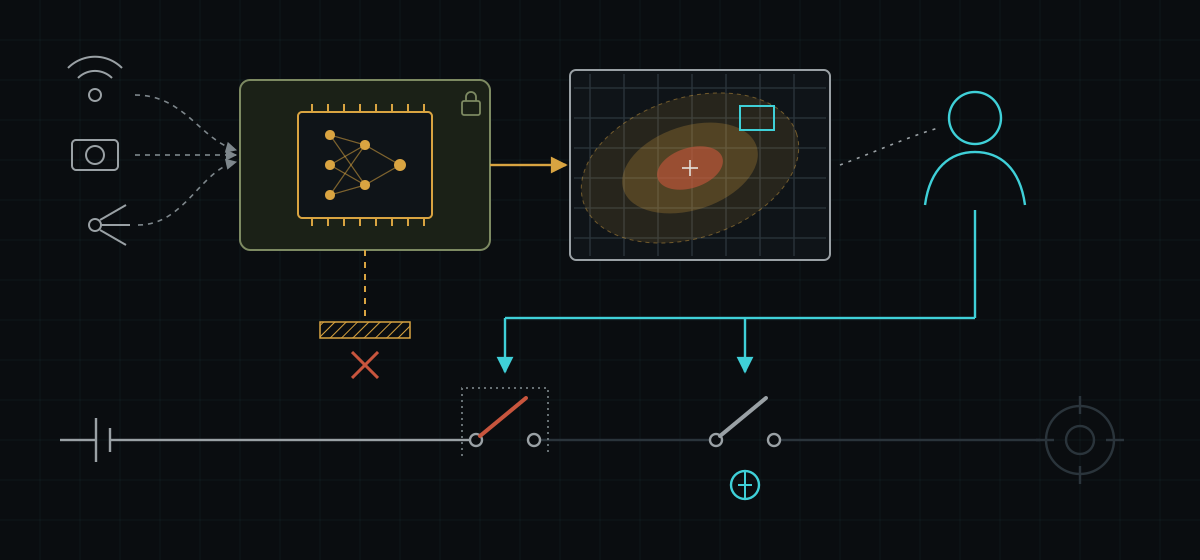
"The override of the interlocks shall not be controlled by a computing system." In addition, §4.5.4/4.5.5 require a safety kernel in non-overwritable memory that cannot be corrupted, misdirected, delayed or inhibited by any other program. |
For the override function, a software solution is not compliant with the alliance standard applied by the national NSAA. No certified silicon or C-UAS vendor references this standard. |
| MIL-STD-1901A §5.2.3.2 |
At least two independent energy interrupters, each controlled by its own safety feature; withdrawing the arming signal automatically returns the firing circuit to the unarmed state. |
This describes the two hardware switches almost verbatim. Two interrupters are a physical construct, not a logical one. |
EDF Regulation (EU) 2021/697
Art. 10(6) |
Actions for the development of lethal autonomous weapons "without the possibility for meaningful human control" are ineligible for funding — explicitly without prejudice to early-warning systems and defensive countermeasures. |
The word "possibility" is operative: a switchable software human-in-the-loop (HITL) safeguard is a weaker answer before an independent ethics assessor than a gate whose absent override path can be demonstrated analytically. That makes the module an eligibility enabler rather than a compliance cost. |
Council of the EU
Conclusions 14436/26, 12 Oct 2026 |
"The key requirement of control and human judgement must be retained across the life cycle of LAWS." Responsibility cannot be transferred to machines; the Council expects an ambitious negotiating mandate. |
Control across the life cycle means control that survives retraining and updates. A fixed hardware monitor provides that; a software setting changes with every release. |
CCW GGE LAWS
Final report, Sept 2026 |
The final report reaffirms that human control and judgement are required for compliance with international humanitarian law; 76 states call for treaty negotiations. Seventh Review Conference: 16–20 November 2026, Geneva. |
However the treaty language is finally worded, a gate whose missing override path can be demonstrated is evidence of control — not merely a declaration of it. |
Federal Government (DE)
Reply 21/5169, 10 Apr 2026 |
Distinguishes automated functions, autonomous functions under human control and fully autonomous systems; rejects systems beyond human control and supports their international prohibition. |
The policy line of the German customer matches the architecture: autonomous functions may advise, the human keeps control. |
EU AI Act (EU) 2024/1689
Art. 2(3), Recital 24 |
Art. 2(3) fully exempts systems placed on the market exclusively for military, defence or national security purposes; Recital 24 pulls in any system also placed on the market for civil or law-enforcement purposes. |
Two separately marketed product lines instead of a single SKU is a design decision, not a legal footnote. It is built into the concept from the outset. |
EU AI Act
Art. 12 / 14 / 15 |
Automatic event logging (Art. 12), a stop function returning the system to a safe state and awareness of automation bias (Art. 14), robustness against data and model poisoning plus technical redundancy (Art. 15). High-risk obligations for law enforcement and critical infrastructure apply from 2 December 2027 (Regulation (EU) 2026/1744). |
For the police variant this maps almost mechanically: the inhibit line as the stop into a safe state, signed release logs as logging, the independent safety island as the second channel. |
DoDD 3000.09
(reissued 25 Jan 2023; under revision per NSPM-11 of 5 Jun 2026) |
Requires appropriate levels of human judgement over the use of force, explicitly names supply-chain infiltration as a failure class, and at the same time calls for rapid reprogrammability of autonomy algorithms. |
Reprogrammability is operationally necessary and hostile to assurance. The hardware monitor resolves the contradiction by bounding the unassured function — precisely the pattern ASTM F3269-21 legitimises for run-time assurance. |